Think Aloud Evaluation Method

Introduction

The is the third practical we have received for the module Human Factors in HCI. In this practical we were tasked with using the think aloud evaluation method. This is where we observe how users interact with an interface and how they carry out given tasks. We do this by listening to their thoughts throughout. This helps to understand the thought process behind each action taken so that developers may improve upon their product’s usability, navigation, and overall quality.

My chosen website was https://www.bulbagarden.net/ a fan made Pokémon wiki containing news and information on all forms of Pokémon media from games to movies. Below are the tasks I asked my two users to carry out and the results.

Tasks

  1. Navigate to the “legendary” category page.
  2. Search for a specific Pokémon i.e., Pikachu.
  3. Locate the websites social media accounts (Facebook, Twitter, and YouTube etc).
  4. View anime news.
  5. Read a forum thread.
  6. Post thread in the forums (just find).
  7. Login/register (just find).
  8. Change the language.

User 1 (Thomas Creighton – K00253257)

  1. Found after some effort by clicking the Bulbapedia dropdown and said “legendary” is an unknown term if you don’t know Pokémon.
  2. Straight forward to find, used the search bar.
  3. Found after some effort, checked the footer before finding under the more dropdown.
  4. Straight forward to find, clicked news and anime news.
  5. Straight forward to find, clicked forums, and clicked on a thread.
  6. Straight forward to find, already in forums clicked the post thread button.
  7. Straight forward to find, clicked the account dropdown.
  8. Very hard to find the language dropdown as it was hidden, had to be shown the location of.

User 2 (Sean Macalino – K00252336)

  1. Straight forward to find, clicked the Bulbapedia dropdown.
  2. Straight forward to find, used the search bar.
  3. Straight forward to find, went straight to the more dropdown.
  4. Confused news with threads but eventually found news.
  5. Straight forward to find, clicked forums, and clicked on a thread.
  6. Straight forward to find, already in forums clicked the post thread button.
  7. Straight forward to find, clicked the account dropdown.
  8. Very hard to find the language dropdown as it was hidden, had to be shown the location of.

Evaluation Findings

Both users interacted with the interface in different ways. Some tasks were easier to complete for one user than they were for the other i.e., task 3.  Little assistance was needed for both users besides task 8 where I had to show both users where the feature was. They both generally navigated the website the same way I did through my initial testing likely meaning the interface was good overall besides the few issues encountered.

What I learned

From this practically I learned that it is beneficial to look at and listen to a user as they are evaluating your product so that you may find its strengths and weaknesses. This method is effective as it is cheap and provides live feedback to the developer.

If a user either struggles to find a certain feature or carries out a certain task in a different way to what you expected your interface is possibly convoluted. Issues such as these can be identified and solved quickly using the think aloud evaluation method.
Human Factors in HCI Practical 2 – Mind Palace

Introduction

Hello and welcome back to my blog! This is my reflection on practical 2 for Human Factors in HCI. Here I will discuss the objective of this practical along with the process, challenges faced, and lessons learned.

Objective

The objective of this practical was to create a mind/memory palace of a place we know well and use this memory palace to aid us in remembering the items on a shopping list. This list was about 20 items long and we were supposed to remember what each item on the list was and be able to name the items in both normal and reverse order.

Process

I started by choosing a place that I know well which is my bedroom. I then planned a route around my room taking note of around 20 objects/landmarks and associated each object with an item on the list. The number of objects noted was the same as the amount of items on the list we were to remember. Below are the mentioned objects and items from the shopping list.

  1. Door – Tomatoes
  2. Posters on wall – Penne pasta
  3. Desk – Honey
    • Chair – Brown rice
    • Consoles – Eggs
    • Monitors – Bran flakes
  4. Pillar – Extra virgin olive oil
  5. Sockets – Potatoes
  6. Shelf – Garlic
    • One Piece figure – Carrots
    • Pop figures – Almonds
    • Pop figures 2 – Yogurt
    • Random – Red wine vinegar
    • Plugs – Salsa
    • Books – Plain flour
    • Games – White cabbage
    • Letters etc. – Butter
  7. Drawer – Barbecue sauce
  8. Window – Strawberry jam
  9. Bed – Tomato ketchup

Once I had the route planned and items paired it was time for me to try and remember the list.

Challenges Faced

When trying to remember the list it was very difficult. We had to associate the items with 20 objects from our mind palace which effectively meant we had to memorise 40 different things. Remembering an object or item would push the other out of my memory. Initially I struggled to even remember a few of the items because of this before having to look down at the list again.

Lessons Learned

I found that I was able to remember more by making humorous associations between objects. An example of this is when my lecturer connected my Pokémon poster on my wall to penne pasta by suggesting that I imagine a Pokémon being stabbed by pasta. This helped me remember that item, but I doubt remembering this many funny connections would be viable due to complexity.

I personally think that using this way of remembering things is more trouble than it is worth. You are basically trying to remember double the amount of things you actually need to remember. A lot of time is also spent on creating your mind palace and then matching the items to the objects in your palace.

I prefer to learn things by writing them out or just looking at something and reading it in my mind until it becomes familiar to me but I do see the benefit of this method. This way of memorizing can be useful to those who learn visually and have brains programmed more for this type of learning

Human Factors in HCI

Hello and welcome back to my blog. I haven’t posted in a while!? My name is Andrew and I am 22 years old. My interests include playing games, watching movies and anime.

I started this blog for college assignments pertaining to certain modules. From this blog I will be making posts regarding our college module “Human Factors in HCI” and any work relevant to that module. These posts are intended for my lecturers and other students in the class.

Thanks for reading and come back soon for more!

Space Race (Stage 9: Summary):

As I have completed my board game I feel it is only right to summarize each stage of its development. I will also have links to my blog posts on each stage of development so that you may read them if you haven’t already (LINKS ARE ON STAGE NAMES).

Stage 1:

This is the first version of my game. In this stage I created the game board along with game rules for single and multiplayer.

In multiplayer the aim of the game was to go around the board and be the first to collect fuel. In single player you did the same but went for a high score.

Stage 2: Playtest no. 1:

This is my very first play test where I had 2 of my friends play my game and give me feedback on what I should change to make it better.

The main feedback I received was to improve balance and extend the duration of the game.

Stage 3: Add Rules:

This is the second version of my game. In this stage I made some additional rules for the game and in accordance with the feedback I received from Stage 2 I changed my board and some of the values on it so the game would last longer.

The additional rules being a change to the win conditions in multiplayer and changing the values of most of the Snilite squares.

Stage 4: Playtest no. 2:

This was my second play test where i received more feedback such as adding more Sci-Fi elements to my game and also changing the shape of the board to resemble a planet.

Stage 5: Add Story:

This is the third version of my game in which like the feedback suggested I added more Sci-Fi elements to the game. In this stage I also included a shorty to give the game more context and gave the board some colour.

Stage 6: Playtest no. 3:

My third play test for this board game of mine. I received feedback such as add more unique squares to the board and change the board so that it is not mirrored/symmetrical.

Stage 7: Add Multiplayer:

This is the final version of my where I was tasked with adding multiplayer. As I had already added multiplayer to my game in a previous stage I will not go into further detail here.

Stage 8: Playtest no. 4:

My final play test!!! At this point I had ironed out all the problems with my game and as a result there was little to no feedback at this point that I felt like taking on board.

Space Race (Stage 8: Playtest no. 4):

Play-testing my game were two of my friends who I shall refer to as Player 1 and Player 2. They both played the game in single and multiplayer.

Below I will mention each person’s feedback and then briefly describe what I am going to change based on the feedback and my own observations and why in a separate section.

Note: Since my last play test I have not made any change to the game board or the rules of the game.

Player 1’s Feedback:

  • Said that he had fun playing my game.
  • The balance of the game was a bit off. He thought that the number of snilite gained moving around the board is too high in comparison to the amount of snilite that can be stolen from other players.

Player 2’s Feedback:

  • Said that I should make the board a bit longer so it takes more time to get the fuel bonus from completely going around the board.

My Observations:

With this being the final version of my game, everything is refined and worked perfectly as a result. Both of them definitely had great fun while playing my game. They were both

What I Will Change Based On The Feedback I Received:

Similarly, to my last play test I don’t feel the need to make any changes to my game and I am more than happy to leave it as it is. To me it is a finished product at this stage in development.

Space Race (Stage 7: Add Multiplayer):

In this stage of the game I was tasked with adding multiplayer to my game. Below are my multiplayer rules.

Multiplayer Rules:

  • Players take turns rolling a 6 sided dice to move around the board collecting snilite as they go.
  • Players get snilite when they land on a certain type of square. This square specifies how many snilite the player receives and they add it to their total. This square is highlighted in blue on the board.
  • Players can also lose snilite in the same way by landed on a square that takes away snilite from that player. This square is highlighted in red on the board. If a player has less snilite than the amount that will be subtracted they have a negative total.
  • 1 fuel is equal to 20 snilite and is converted automatically.
  • If a player lands on a square that says “Extra Turn” they receive no snilite but get to roll again. This square is highlighted in green on the board.
  • If a player lands on a square that says “Lose Next Turn”, that player’s next turn is skipped entirely. This square is highlighted in red on the board.
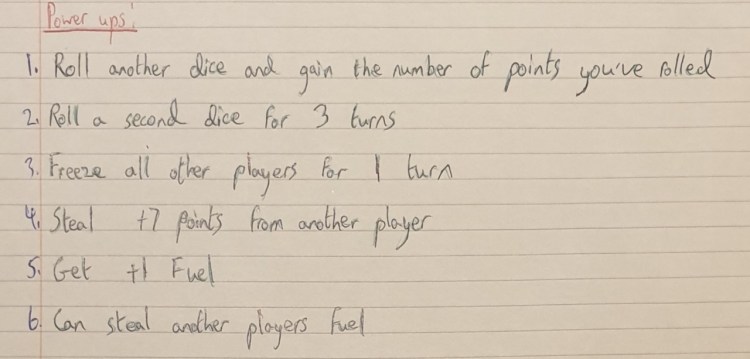
  • If a player lands on a square that says “”Roll For A Power Up” they roll a dice and depending on the roll they receive a power up which is used automatically. Power Ups are still the same. This square us highlighted in pink on the board.
  • When stealing snilite from another player if the player chosen has less than snilite that will be subtracted they have a negative total number of snilite and the player stealing still receives the full number subtracted. This power up cannot steal fuel. Players can choose who to steal from.
  • When stealing fuel from another player if every player has no fuel to steal then the power up does nothing. Players can choose who to steal from.
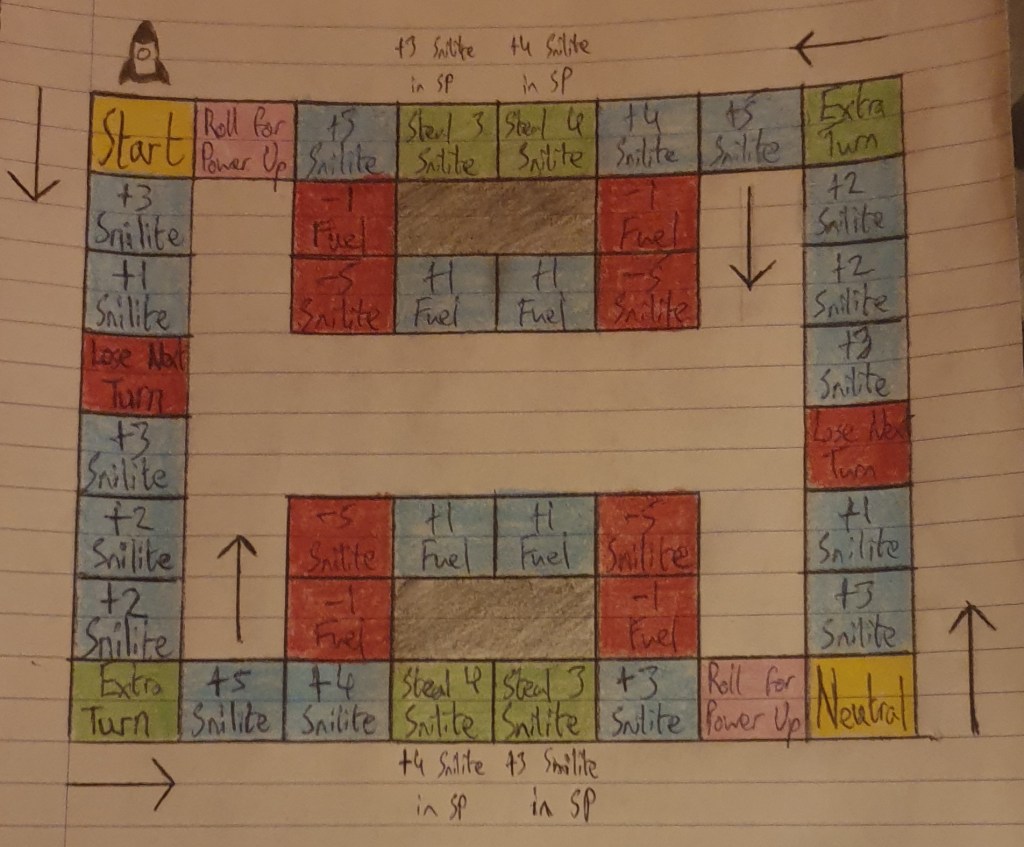
  • At the top and bottom of the board there are sections where players can choose which direction they want to go but must call it before hand. This is done because this optional route has a high chance of reducing your fuel and snilite and prevents players from deciding to not go down the optional route if they would land on a fuel/snilite reducing square.
  • If a player reaches the starting point on the board they receive 1 fuel and continue to go around the board again until they have won if they haven’t done so already.
  • The game is won when a player has obtained 5 fuel.

Space Race (Stage 6: Playtest no. 3):

Play-testing my game were two of my friends who I shall refer to as Player 1 and Player 2. They both played the game in single and multiplayer.

Below I will mention each person’s feedback and then briefly describe what I am going to change based on the feedback and my own observations and why in a separate section.

Player 1’s Feedback:

  • Player 1 recommended that I make the board non-symmetrical and to also have more unique squares.
  • He said overall enjoyed playing the game and its competitive nature in multiplayer.
  • Liked when he was able to steal from the other players.

Player 2’s Feedback:

  • To change the shape of the board to something more circular as to resemble a planet.
  • In single player include more squares that will reduce your Snilite and fuel as to make getting a higher score in single player even harder.

My Observations:

The two lads seemed to have enjoyed the game especially Sean as he had play tested an older version of my game for me. They also liked the addition of the colour to the board as it previously had no colour.

What I Will Change Based On The Feedback I Received:

Despite the feedback that I received I am happy with the current state of my game and think that I don’t need to make any more changes at least for the moment.

Space Race (Stage 5: Add Story):

In this stage of development of my board game I am introducing a story to it. I’ve also made some changes to the board to make it more Sci-Fi themed which I will detail below.

Story:

It is the year 2150 and you are on the planet Zerth. An asteroid is heading straight for your planet. Your only chance of survival is escaping the planet on a space ship but fuel is limited. You must collect as much Snilite, the mineral used to make fuel on your planet as possible to power your ship and escape the planet. You will likely have to fight others for fuel. Its a race to get to space. Welcome to SPACE RACE.

Updated Game Board:

I added a rocket at the starting point and renamed the points to Snilite and have coloured the board.

Space Race (Stage 4: Playtest no. 2):

Play-testing my game were two of my friends who I shall refer to as Player 1 and Player 2. They both played the game in single and multiplayer.

Below I will mention each person’s feedback and then briefly describe what I am going to change based on the feedback and my own observations and why in a separate section.

Player 1’s Feedback:

  • Player 1 recommended I add more Sci-Fi elements to the game which I think is a good idea moving forward as I have the core mechanics of the game almost perfected.
  • Add more squares to the board that when landed on penalise you and reduce your points in the single player version of the game.

Player 2’s Feedback:

  • Similarly, Player 2 had also advised me to add more Sci-Fi elements to the game. His reasoning for this is that will allow players to be more immersed in the experience while playing this game.
  • He also told me to increase the number of points that will be subtracted from players if they land on a lose points square as he thinks that at the moment the points deducted are not as big of “problem” in his opinion.
  • Change the positions of the squares around so that the board is not mirrored as I currently have it i.e. the positions of the points and power ups etc.

My Observations:

Like Player 1 and Player 2 said in the single player version of the game there could be more squares on the board that penalise your score if you land on them which makes getting a high score more difficult and fun.

In the multiplayer version of the game I noticed that it took a lot more time for one person to win in comparison to the first version of my game which is what I wanted. Player 1 and Player 2 also stole from each other a few times which made the game more fun in their opinion.

Overall, they both enjoyed the game and had a BLAST (pun intended).

What I Will Change Based On The Feedback I Received:

Based on this feedback I think I will change the single player version of the game to have more squares that penalise you if you land on them.

I also think in the next version of my game I will add more Sci-Fi elements to the game such as renaming the “points” to something different to fit more with the theme I set out to make this game about.

Design a site like this with WordPress.com
Get started